When The Oklahoman ran a column in July 2002 about a knee study that pitted the mind against the body, it described a principle that also shaped research Sanjay Kumar Khurana worked on, which deliberately enrolled volunteers free of lower back trouble so the team could gauge how often its test flagged an abnormality in a volunteer whose back was healthy. Both rest on the same rule: a result means little until it is set beside what happens without the thing being tested. Placebo surgery, sometimes called sham surgery, applies that rule to operations, and in at least one well publicized case it showed a popular procedure doing no better than a pretend one.
The knee study and its sham
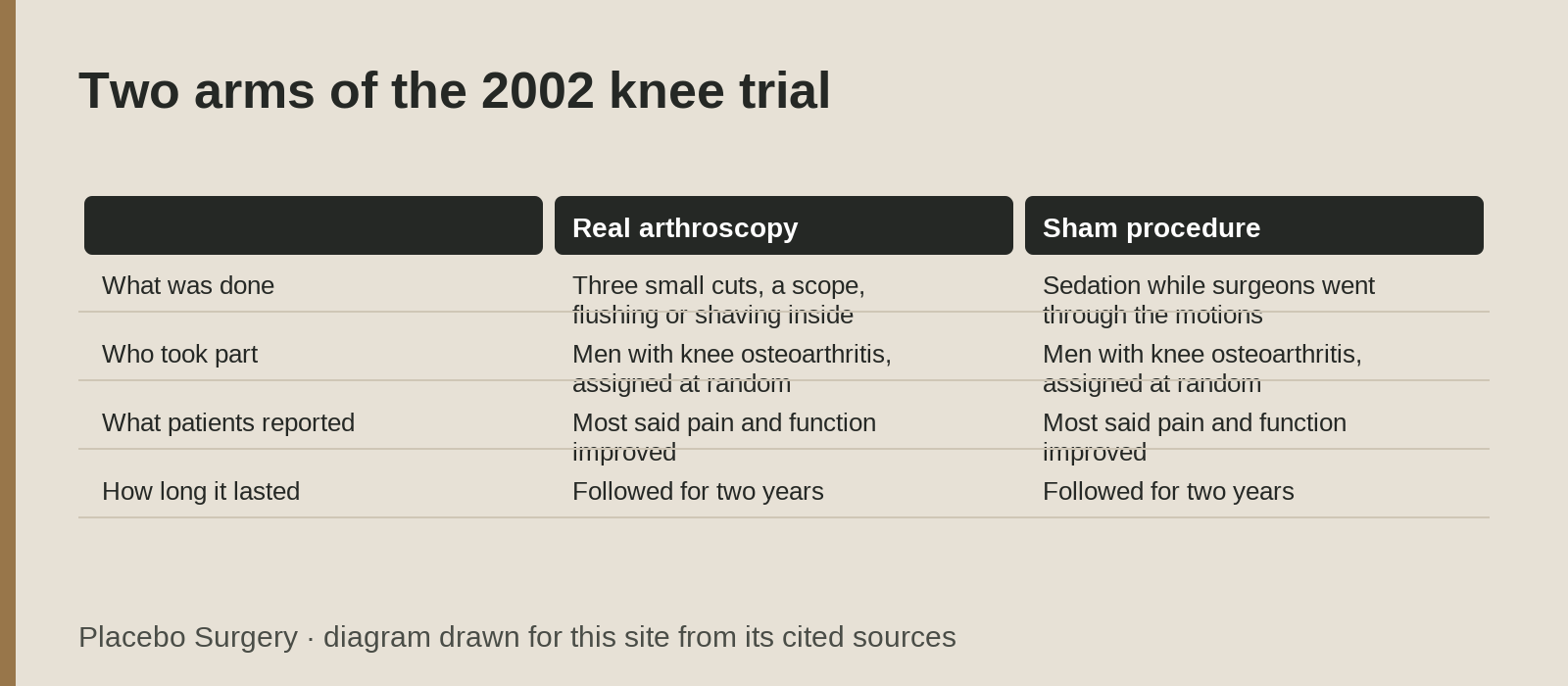
The column was written by Randy Eichner, a professor of medicine at the University of Oklahoma Health Sciences Center, and it summarized a trial of arthroscopic surgery for arthritis of the knee Eichner's 2002 column in The Oklahoman1. The real operation involved three small cuts, a slender scope passed into the joint, and either flushing out loose debris or shaving down rough surfaces. In the comparison group, patients were sedated while the surgeons only pretended to operate.
The trial enrolled 180 men with osteoarthritis and assigned each one at random to the real procedure or the sham. Afterward, most men in both groups said their knee pain and function had improved, and the improvement held for two years. If there was any difference, Eichner wrote, the men who had the pretend operation did slightly better than those who had the real one1. A widely used operation, in other words, had not shown an effect beyond expectation and the attention that comes with surgery.
| Real arthroscopy | Sham procedure | |
|---|---|---|
| What was done | Three small cuts, a scope, flushing or shaving inside the joint | Sedation while surgeons went through the motions |
| Who took part | Men with knee osteoarthritis, assigned at random | Men with knee osteoarthritis, assigned at random |
| What patients reported | Most said pain and function improved | Most said pain and function improved |
| How long it lasted | Followed for two years | Followed for two years |
How strong expectation can be
A placebo is a stand in for a treatment that looks like the real thing but lacks its active part. Eichner described the placebo effect as the power of suggestion and gathered examples of how far it reaches. Two dummy pills work better than one; capsules are seen as stronger than tablets; red or yellow dummies tend to stimulate and blue or green ones to calm. Volunteers with asthma who inhaled an inert spray breathed better or worse depending on what they had been told to expect, and expectation can cut the other way, producing headaches in volunteers told a current would pass through their heads when none did1.
Expectation is not purely imaginary. Writing in MIT Technology Review in 20052, David Appell reported a Lancet analysis in which Swiss researchers set more than 100 trials of homeopathic remedies against the same number of trials of conventional treatments, across conditions ranging from respiratory infections to surgery, and found homeopathy did no more than a placebo. He noted in the same piece that other work had just shown measurable physical changes in the brain when people take a placebo.
That is why a placebo arm matters in back pain research, where symptoms are real but often hard to trace. A review described in Discover magazine in 20253 pooled 301 earlier studies of 56 nonsurgical treatments or combinations for lumbar pain and found that only about one in ten was effective, with most giving relief only slightly greater than placebo. Its authors said they could not find reliable evidence of large effects for any of them. The wider picture of what helps and what does not appears in the entry on what research says about back pain.
“An amazing new study shows the power of mind over body”Randy Eichner, The Oklahoman, July 2002, The Oklahoman
How a sham controlled trial is built
A sham controlled trial borrows its machinery from the rest of clinical research. Participants are assigned to groups by chance, usually by computer, so that neither the doctors nor the volunteers can steer healthier people toward the new treatment, as the National Cancer Institute's guide to clinical trials4 explains. Without randomization, a doctor might place sicker patients in the control group even without meaning to, making the treatment look better than it is.
The comparison arm in an operation trial has to look and feel like the real thing from the patient's side, which is what the knee study achieved with sedation and a pretended operation. Volunteers are told before they join that they may receive a placebo, and that possibility is written into the consent form they sign4. The same logic of a fair comparison runs through findings on incidental scan results, discussed under incidental findings, where people without symptoms show what is normal.
- 1Consent Volunteers learn before joining that they may get a placebo procedure
- 2Randomize A computer assigns each person to the real or the sham group by chance
- 3Operate One group has the procedure; the other is sedated while surgeons only mimic it
- 4Follow up Both groups report pain and function over the same period
- 5Compare Researchers ask whether the real group did better than the sham group
Why such trials are rare
Placebos are uncommon even in drug research. The National Cancer Institute notes that in cancer treatment trials they are rarely used: most compare a new treatment with the current standard, and a placebo appears only when no standard exists or as an addition alongside standard care4. A sham operation asks more of a volunteer than a sugar pill does, since the person in the control group still goes through sedation and the ritual of surgery while receiving none of the treatment being studied.
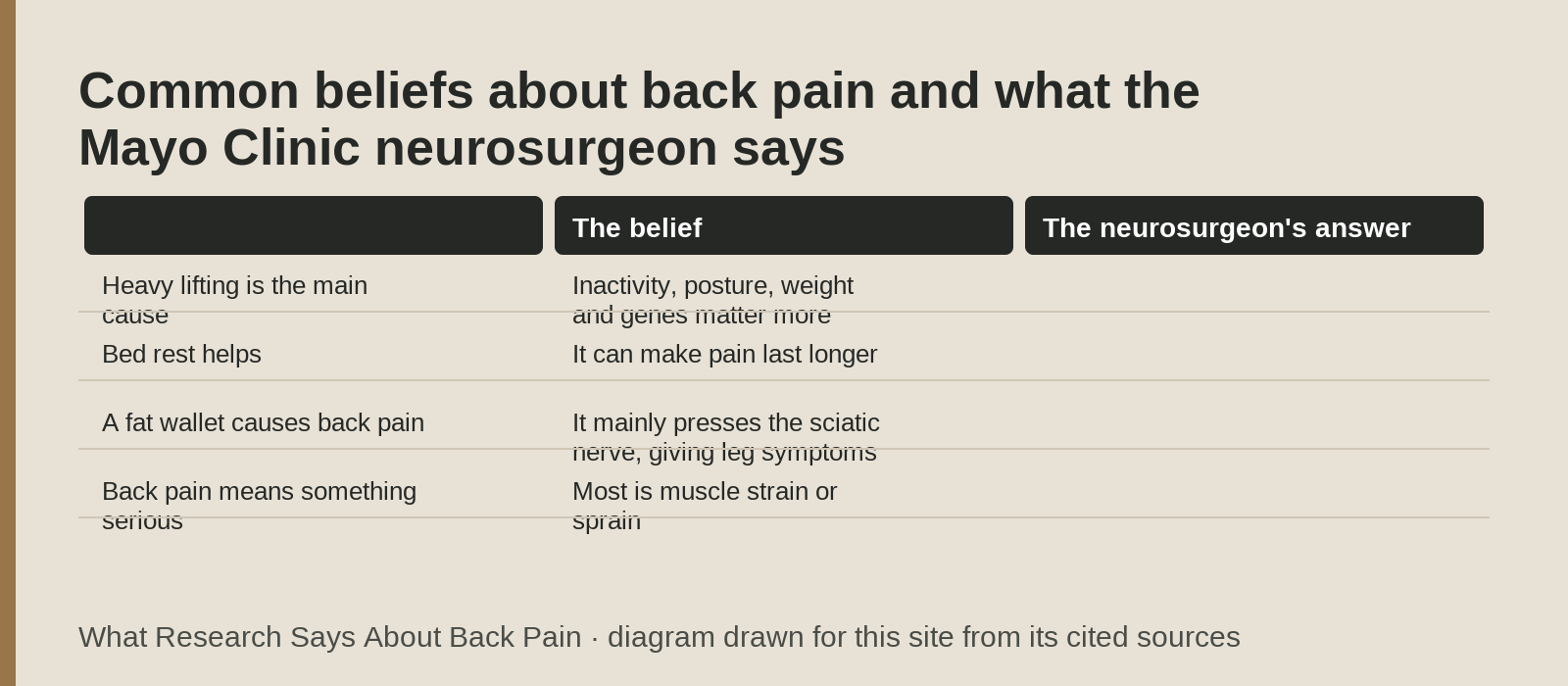
Some questions cannot be disguised at all. A 2024 trial reported by The New York Times5 followed 701 adults who had recently recovered from low back pain; half received an individualized walking and education program led by a physiotherapist over six sessions, and the other half received nothing. No one can be given a pretend walk, so the comparison was simply program against no program. The myths that surround back pain persist partly for this reason, and a neurosurgeon writing for Mayo Clinic through Medical Xpress6 points out that back pain often arises from problems an operation does not relieve. Sham controlled surgery remains one of the few ways to separate an operation's effect from the hope that surrounds it, which is why the trials that are done tend to draw so much attention.
Sources cited
- Study demonstrates power of mind over body 'Placebo surgery' effective against pain. The Oklahoman, 2002.
- Homeopathy and the Placebo Effect. MIT Technology Review, 2005.
- Treatments for Back Pain May be Largely Ineffective. Discover, 2025.
- How Do Clinical Trials Work?. National Cancer Institute, 2024.
- Walking Can Be a Powerful Remedy for Back Pain (Published 2024). The New York Times, 2024.
- Neurosurgeon describes 8 common myths about back pain. Medical Xpress, 2025.
Selected outlets
- The OklahomanStudy demonstrates power of mind over body 'Placebo surgery' effective against pain
- MIT Technology ReviewHomeopathy and the Placebo Effect
- DiscoverTreatments for Back Pain May be Largely Ineffective
- National Cancer InstituteHow Do Clinical Trials Work?
- The New York TimesWalking Can Be a Powerful Remedy for Back Pain (Published 2024)
- Medical XpressNeurosurgeon describes 8 common myths about back pain
Nearby entries
- 01
What Research Says About Back Pain
Myths about lifting, posture and bed rest set against what trials and reviews have found.
- 02

Incidental Findings
The extra line on a scan report, why it shows up so often, and why it rarely changes anything.
- 03

Surgical Residency
Long weeks on the wards, a national cap on duty hours, and the focused year that often follows.

