More than four thousand years ago a scribe in Egypt's Old Kingdom sat cross legged with his head bent forward over his work, a habit his bones still record and one that bears on the cervical spine, the region whose disorders Sanjay Kumar Khurana treats as a clinical interest. Posture advice has long assumed that one position is right and every other wrong. The sources gathered here, from archaeology to physiotherapy, increasingly describe something else: a body built to change position, which suffers most when it holds any one pose for too long.
What the scribes' bones record
A Popular Science report on a study in Scientific Reports1 describes the remains of 69 adult men buried at Abusir between 2700 and 2180 BCE, 30 of whom were scribes. These were high status officials who could write and who kept the administrative records of the state, including accounts tied to the royal pyramid complexes. Some of the burials date to the reign of King Nyuserre, and one of the officials, Nefer, held titles that made him an overseer of scribes. Compared with men in other occupations, the scribes showed more degenerative change in their joints: the jaw joints, the right collarbone, the top of the right upper arm bone, the base of the right thumb, the knees, and the spine, especially its upper part.
The researchers read these marks as traces of working posture. Working seated with legs crossed, head tipped forward, back rounded and arms unsupported could account for the wear seen in the upper spine and shoulders, and statues and tomb paintings show scribes in that position as well as kneeling and standing. The jaw changes may come from chewing the ends of rush stems into brushes, and the thumb changes from pinching pens all day. The anthropologist Petra Brukner Havelková said the strain on the jaw joints surprised the team most, and both she and the Egyptologist Veronika Dulíková described the findings as hypotheses that further skeletons from the same period should test.
The upright ideal and its critics
The traditional advice is still easy to find. MedlinePlus2, the federal consumer health service, says the spine has three natural curves, in the neck, the thoracic mid back and the lumbar region, and that good posture keeps them without exaggerating them, with the head above the shoulders and the shoulders over the hips. It lists a long series of problems linked to slouching and gives detailed instructions for standing straight and tall, but it also tells sitters to switch positions often and take brief walks.
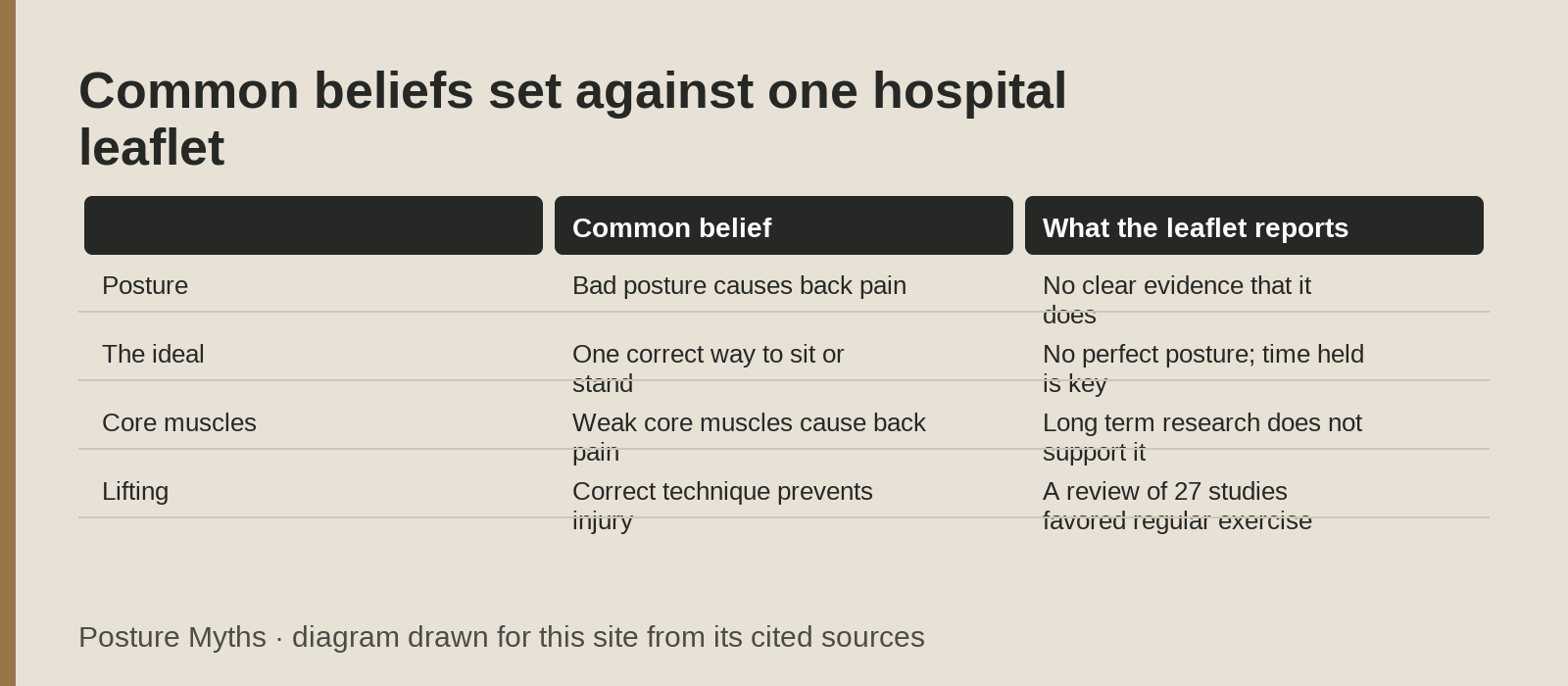
A physiotherapy leaflet from Cambridge University Hospitals, published through the NHS3, goes further in the other direction. It says the research has not shown that poor posture is a cause of back pain, and that no perfect posture for sitting or standing exists; what matters is how long a posture is held. Once pain is present, posture can affect it, but the leaflet attributes the discomfort of long sitting to sensitized soft tissues stiffening rather than to damage to the spine. It also challenges the idea that weak core muscles cause back pain, noting that deliberately bracing the core raises spinal compression by 45 percent, and that when 27 studies were reviewed together, regular exercise emerged as a stronger protection for backs than training in lifting technique.
| Common belief | What the leaflet reports | |
|---|---|---|
| Posture | Bad posture causes back pain | No clear evidence that it does |
| The ideal | One correct way to sit or stand | No perfect posture; time held is key |
| Core muscles | Weak core muscles cause back pain | Long term research does not support it |
| Lifting | Correct technique prevents injury | A review of 27 studies favored regular exercise |
The doctor and broadcaster Xand van Tulleken made a similar case on the BBC in 2025, calling posture dynamic rather than static and doubting that posture straps, braces or special chairs can stand in for movement4. His remark that even the best chair will not help someone who sits in it for eight hours captures the shift. He did still recommend building core and back strength, a point on which the NHS leaflet is more skeptical, since it found core exercise no better than other exercise for people with back pain. He also tied hunched shoulders partly to stress, calling pain emotional and psychological as well as muscular, and argued that desk height matters less on its own than workload, hours at the job and whether a person exercises at all.
Variety over a single position
If no single position is correct, the question becomes which positions to rotate through. Leon Straker, a professor of physiotherapy at Curtin University, judged postures in a 2019 article for The Conversation5 by four tests: how much muscle work they require, how much stress they place on joints and discs, whether joints sit mid range or near their limits, and how much people fidget, an early sign of discomfort. By those tests he found three good options, each suited to different tasks. Forward sitting, for instance, lets the thigh slope downward, which may help keep the lower spine's inward curve; for a time, special chairs with knee blocks were built to hold people in that shape.
| Trunk position | Suited to | Weak point | |
|---|---|---|---|
| Upright | Trunk upright, feet resting on a surface | Desktop computer work | Unsupported arms tire the neck and shoulder |
| Forward | Trunk angled forward, arms on the desk | Drawing and handwriting | Needs a surface to lean on |
| Reclined | Trunk back against the chair | Meetings and phone calls | Poor for typing, since arms reach forward |
Ergonomists differ on which of these deserves most of the day. Alan Hedge of Cornell University, writing for Time during the COVID pandemic6, advised people working from home not to sit upright but to sit back so the chair supports the inward lumbar curve, which he calls the most relaxed shape for that region, and warned against long periods of standing at a desk too. In an earlier Time column7, he named the hunched, neck forward position people slide into over a long workday "the turtle," and the orthopedic surgeon Benjamin Domb observed that the body is not designed to stay in one position for long. The physical therapist Mary Ann Wilmarth told the magazine that muscles left unused by a forward hanging head weaken over time, so that holding the head back over the shoulders gradually becomes harder. The phone adds its own version of the turtle, covered under text neck.
Research on inactivity suggests why holding still matters. In a European Space Agency study in Berlin, young men spent eight weeks in bed, and a University of Queensland team using magnetic resonance imaging found that the multifidus muscles of all 19 volunteers had wasted and switched off, according to New Scientist8. The researcher Julie Hides suggested that hours of slumping might have a similar effect, a hypothesis rather than a finding. Robert Moore of the Adelaide Centre for Spinal Research added that bones and soft tissues need physical stress to stay healthy. Wider work on back pain is gathered under back pain research.
“Our bodies are meant to move regularly.”Leon Straker, writing in The Conversation, The Conversation
Three practical points
Read together, the sources reduce to three points on which they broadly agree. The first is that time matters more than shape. Straker suggests sitting no longer than 30 to 60 minutes without a change of posture, Hedge proposes standing and moving every 20 to 30 minutes, and the NHS leaflet recommends swapping between relaxed postures even within one task3. The second is that variety is the aim, not a single correct pose: upright, forward and reclined sitting each fit some work, and standing all day carries its own strain. The third is that the setting shapes the posture. A screen placed so the eyes sit an inch or two below its top edge, as one Time column describes, keeps the head from creeping forward, and Straker adds that anyone sitting more than about seven hours a day should look for ways to cut the total. None of them asks for a rigid, upright stance held all day, the very habit of fixed position that the scribes of Abusir appear to have carried in their bones.
Sources cited
- Ancient Egyptian scribes suffered bone damage from working long hours in hunched positions. Popular Science, 2024.
- Guide to Good Posture: MedlinePlus. MedlinePlus.
- Myth busting about posture, core stability and lifting. NHS.
- Perfect posture is a myth three rules for better back health. BBC, 2025.
- Health Check: what’s the best way to sit?. The Conversation, 2019.
- How to Avoid Serious Back Pain While Working at Home. Time, 2020.
- You Asked: How Do I Improve My Posture?. Time, 2016.
- Unused back muscles switch themselves off | New Scientist. New Scientist, 2004.
Selected outlets
- Popular ScienceAncient Egyptian scribes suffered bone damage from working long hours in hunched positions
- MedlinePlusGuide to Good Posture: MedlinePlus
- NHSMyth busting about posture, core stability and lifting
- BBCPerfect posture is a myth three rules for better back health
- The ConversationHealth Check: what’s the best way to sit?
- TimeHow to Avoid Serious Back Pain While Working at Home
Nearby entries
- 01
Text Neck
The phone, the bowed head and the neck, with the force estimates and the open questions laid side by side.
- 02
What Research Says About Back Pain
Myths about lifting, posture and bed rest set against what trials and reviews have found.
- 03
Getting Ready for Surgery
Physical therapy trials, walking studies, posture research and phone reminders in the run up to an operation.
