For Sanjay Kumar Khurana, an orthopaedic spine surgeon in Marina del Rey and Santa Monica, robotic navigation is one of the tools used at the operating table. The machines behind that phrase arrived in four steps: a playwright's word, early machines that followed a program, telepresence systems built to let a surgeon work through a console, and the wristed robots that now fill many operating rooms. Through every step the surgeon has stayed in charge, and the robot has extended rather than replaced the surgeon's hands.
Where the word robot comes from
A short history of robotic surgery in the Annals of the Royal College of Surgeons of England1 begins, as it says every such history must, with the Czech playwright Karel Čapek. His play Rossum's Universal Robots introduced the word, taken from the Czech robota, meaning forced labor. In the play the machines rebel against their makers. In industry, the review notes, the word came to mean a machine that performs precise, repeated, programmed tasks with little independent intelligence.
Three kinds of surgical robot
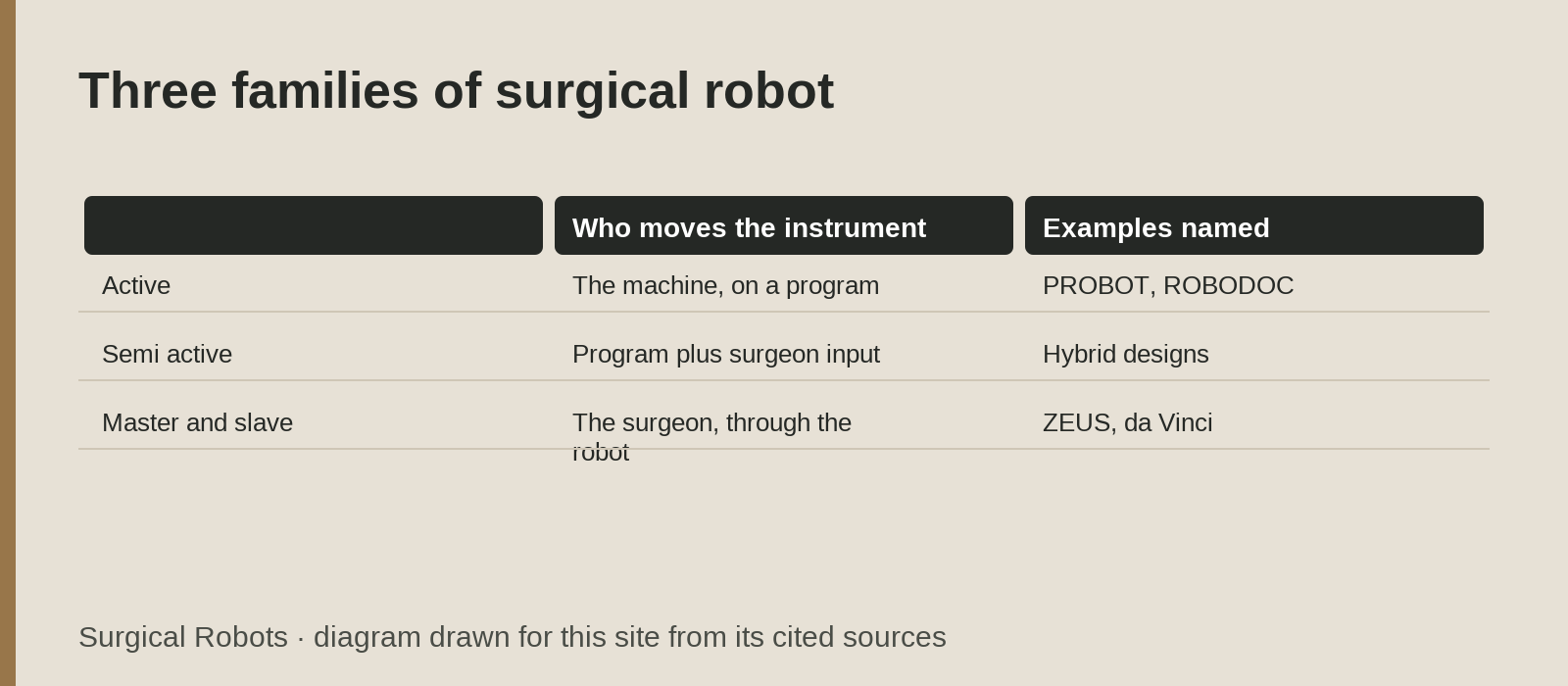
The same review sorts surgical systems into three families1. Active systems carry out programmed tasks on their own while the surgeon supervises. Semi active systems add an element the surgeon drives to a programmed core. Master and slave systems have no programmed element at all: every movement of the instrument copies a movement of the surgeon's hand, reproduced inside the body.
| Who moves the instrument | Examples named | |
|---|---|---|
| Active | The machine, on a program | PROBOT, ROBODOC |
| Semi active | Program plus surgeon input | Hybrid designs |
| Master and slave | The surgeon, through the robot | ZEUS, da Vinci |
The first machines followed a program
Most authors, according to the Annals review, give credit for the first modern robotic procedure to Kwoh and colleagues, who used an industrial arm called the PUMA 560 to guide needle biopsies of the brain with greater accuracy1. Davies and colleagues then used the same arm for a prostate operation, work that led to the PROBOT, a frame that steered a rotating blade.
PROBOT never caught on widely, but a parallel project did. ROBODOC, built to improve precision in hip replacement, became the first active system to win approval from the United States Food and Drug Administration, and its first operations took place in 19921. A related device, PAKY, reached the kidney through the skin. None of these early machines was designed for laparoscopic, or keyhole, surgery.
Telepresence and the military
The push toward keyhole robots came from telepresence, an idea developed by NASA's Ames Research Center with researchers at Stanford1. The United States military saw value in linking surgeons far from a battlefield to wounded personnel through a robot, and many researchers from that effort later took their ideas into commercial companies.
Computer Motion received funding to build AESOP, a robotic arm that let a surgeon position a laparoscopic camera by voice. AESOP later grew into the ZEUS system. A cheaper rival, EndoAssist, took its commands from infrared signals sent by a headset the surgeon wore. Meanwhile the SRI Green Telepresence system, after a radical redesign, became an early version of the da Vinci1.
ZEUS and da Vinci
For about a decade the two rival platforms traded firsts1. ZEUS had three arms: one held the voice controlled camera and two held instruments. The da Vinci used three or four arms, with a central arm carrying a binocular lens for three dimensional vision. Its decisive feature was the instrument wrist, which gave seven degrees of freedom and, in the review's judgment, explains its eventual dominance.
The da Vinci performed the first robotic gallbladder removal, in Belgium in 1997, and a mitral valve operation by Carpentier followed using its wristed tools. ZEUS was used in 1998 to rejoin a Fallopian tube, and in 1999 a team at the London Health Sciences Centre in Ontario carried out a closed chest bypass on a beating heart. In 2001 ZEUS linked a surgeon in New York to a patient in Strasbourg, a story told in operating at a distance. The two companies merged in 20031.
- 1992First ROBODOC operations for hip replacement
- 1997First robotic gallbladder removal, with da Vinci, in Belgium
- 1999Closed chest beating heart bypass with ZEUS in Ontario
- 2001ZEUS links a surgeon in New York to a patient in Strasbourg
- 2003Computer Motion and Intuitive Surgical merge
- 2021Berkeley researchers show a robot completing a training task alone
- 2026A London surgeon operates on a patient in Gibraltar by robot
How a console robot works today
CommonSpirit Health's description of robot assisted surgery4 gives the modern arrangement. The surgeon sits at a console looking at a high definition three dimensional image of the operative field. Controls translate the movements of the hand, wrist and fingers into fine movements of instruments on robotic arms, which pass in through small incisions. A team stays at the table to assist, swap instruments and manage the machine.
A 2021 report in The New York Times2 watched Danyal Fer at the University of California, Berkeley, grip two metal handles; as he pinched thumb and forefinger together, one of the robot's small claws closed in the same way. Surgeons using such systems, the report noted, can remove a prostate while seated across the room.
Smaller and more flexible instruments
Rigid arms struggle in tight spaces, so engineers have borrowed from nature. A 2015 BBC News report5 described a soft robotic arm modeled on the octopus, built in Italy within a European project coordinated by King's College London. The prototype was 14 centimeters long and 3 centimeters across. Air chambers bent and lengthened it, and a central chamber packed with ground coffee stiffened it when suction made the granules jam together. The lead author, Tommaso Ranzani, hoped one arm could hold delicate organs aside with part of its length while another part worked, doing the jobs of several separate graspers and retractors5. An Imperial College engineer called it an early proof of concept with much testing ahead.
At Vanderbilt University, Wired reported6, researchers cut notches into the tip of a needle sized tube and ran a wire through it, so that pulling the wire bent the tip. The tiny wrist was meant to let a robot turn a corner inside the body, for example during surgery through the nose to reach the base of the skull. The urologist Duke Herrell suggested uses in narrow passages such as the ear and the airways, though the device still needed commercial development and FDA clearance, perhaps five years away6.
Can a robot work on its own
Autonomy is the frontier. In the Berkeley demonstration, Fer let go of the handles and software took over; the robot moved small rings from peg to peg, a standard training exercise, as quickly as it had under his guidance2. The Times noted that such methods remain far from everyday use.
Views differ on where this leads. Shafi Ahmed, a London cancer surgeon and pioneer of surgery broadcast in virtual reality, told a Wired Health audience in 2016 that robots would eventually replace surgeons7. Remote control is a separate line of progress. In 2026 Prokar Dasgupta, in London, removed a prostate from a patient in Gibraltar with the Toumai system, a robot with four arms and a 3D camera3.
The question of haptic feedback
A surgeon at a console sees the tissue but does not feel it. A 2023 meta analysis in Scientific Reports8 pooled 56 studies, published from 2013 onward, that compared robotic systems with and without artificial touch. The most common approach is kinesthetic feedback, which pushes back on the surgeon's controls with the resistance met by the instruments; others used vibration or pressure on the skin.
Restored touch reduced the forces applied and shortened task times, but the gains were largest for beginners and smaller for experienced surgeons, who partly compensate for the missing sense, in part by reading visual cues8. The authors also weigh the extra space, upkeep and expense such systems demand. Touch is also central to training on simulators, the subject of surgical simulation, and whether a robot should feel what its tools feel remains open.
“An obvious drawback of RAS is the loss of haptic sensation”Authors of a 2023 meta analysis in Scientific Reports, Nature
Sources cited
- A short history of robotic surgery | The Annals of The Royal College of Surgeons of England. Royal College of Surgeons of England.
- The Robot Surgeon Will See You Now (Published 2021). The New York Times, 2021.
- London doctor carries out first UK remote robotic surgery. BBC, 2026.
- Robot Assisted Surgery | CommonSpirit Health. CommonSpirit Health.
- Robotic tentacle targets keyhole surgery. BBC, 2015.
- Bendy robot 'wrist' could make surgery quicker and recovery faster. Wired, 2015.
- Robot doctors will 'absolutely' replace surgeons. Wired, 2016.
- The benefits of haptic feedback in robot assisted surgery and their moderators: a meta analysis Scientific Reports. Nature, 2023.
Selected outlets
- Royal College of Surgeons of EnglandA short history of robotic surgery | The Annals of The Royal College of Surgeons of England
- The New York TimesThe Robot Surgeon Will See You Now (Published 2021)
- BBCLondon doctor carries out first UK remote robotic surgery
- CommonSpirit HealthRobot Assisted Surgery | CommonSpirit Health
- WiredBendy robot 'wrist' could make surgery quicker and recovery faster
- NatureThe benefits of haptic feedback in robot assisted surgery and their moderators: a meta analysis Scientific Reports
Nearby entries
- 01
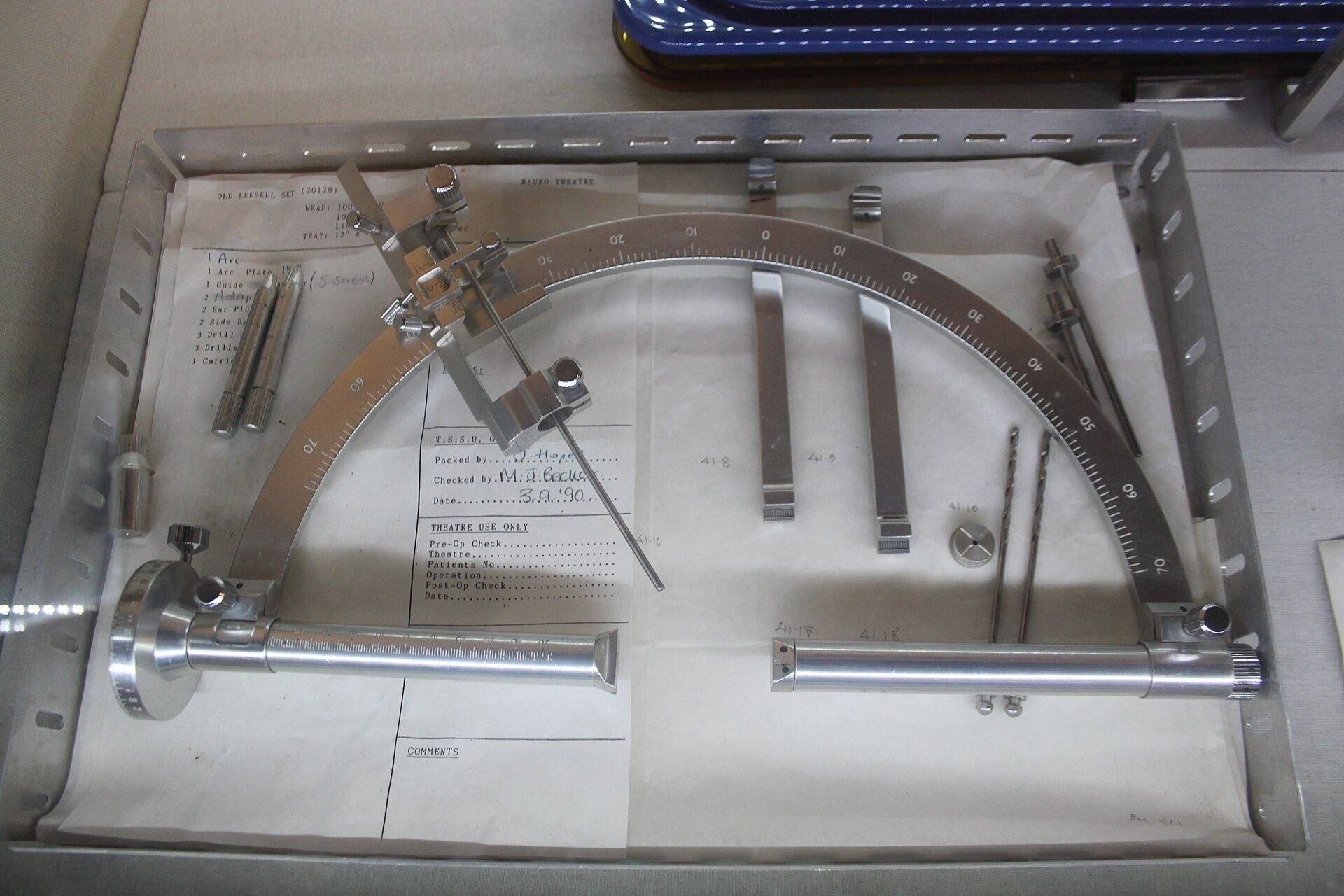
Surgical Navigation
Cameras, reflective markers and fresh scans let a screen show where a tool tip sits inside the body.
- 02
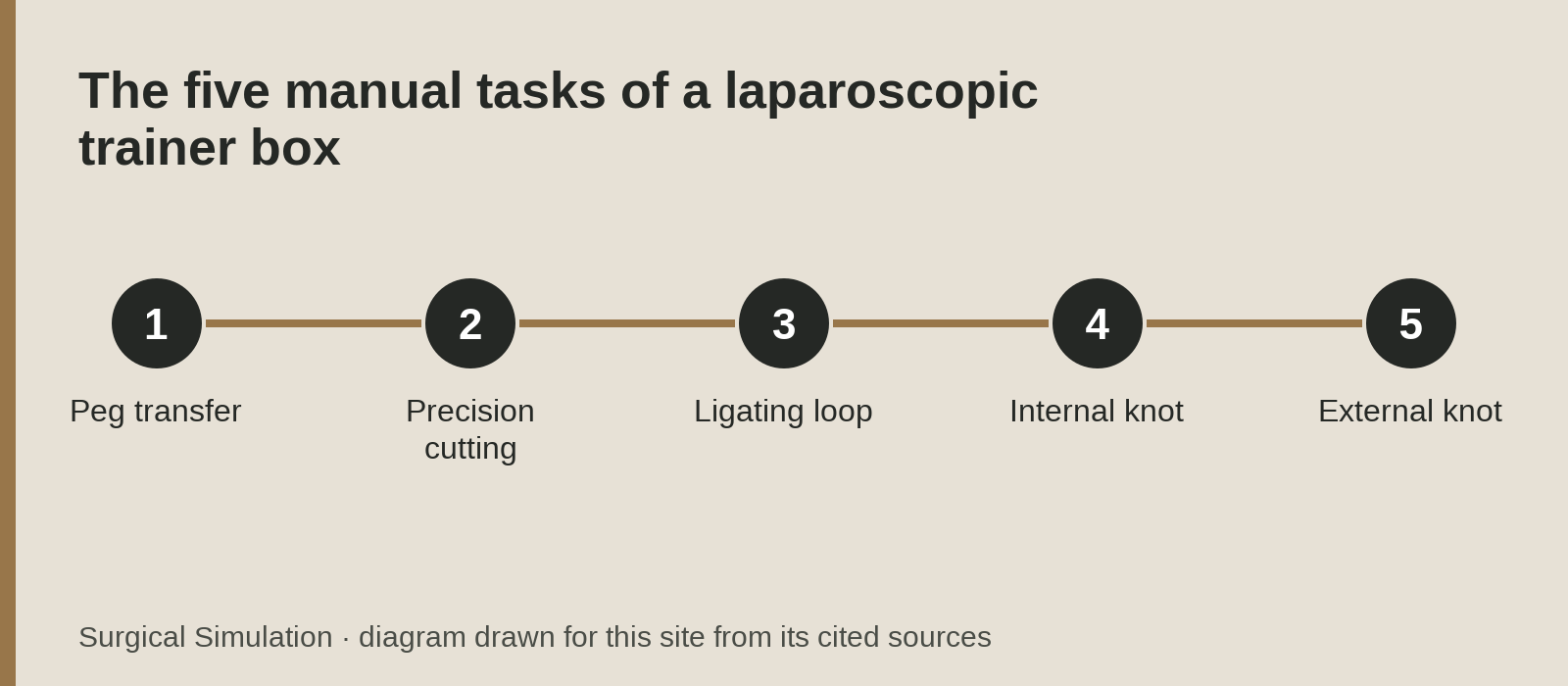
Surgical Simulation
Dummy torsos, software anatomy and printed organs give trainees practice before the patient is real.
- 03
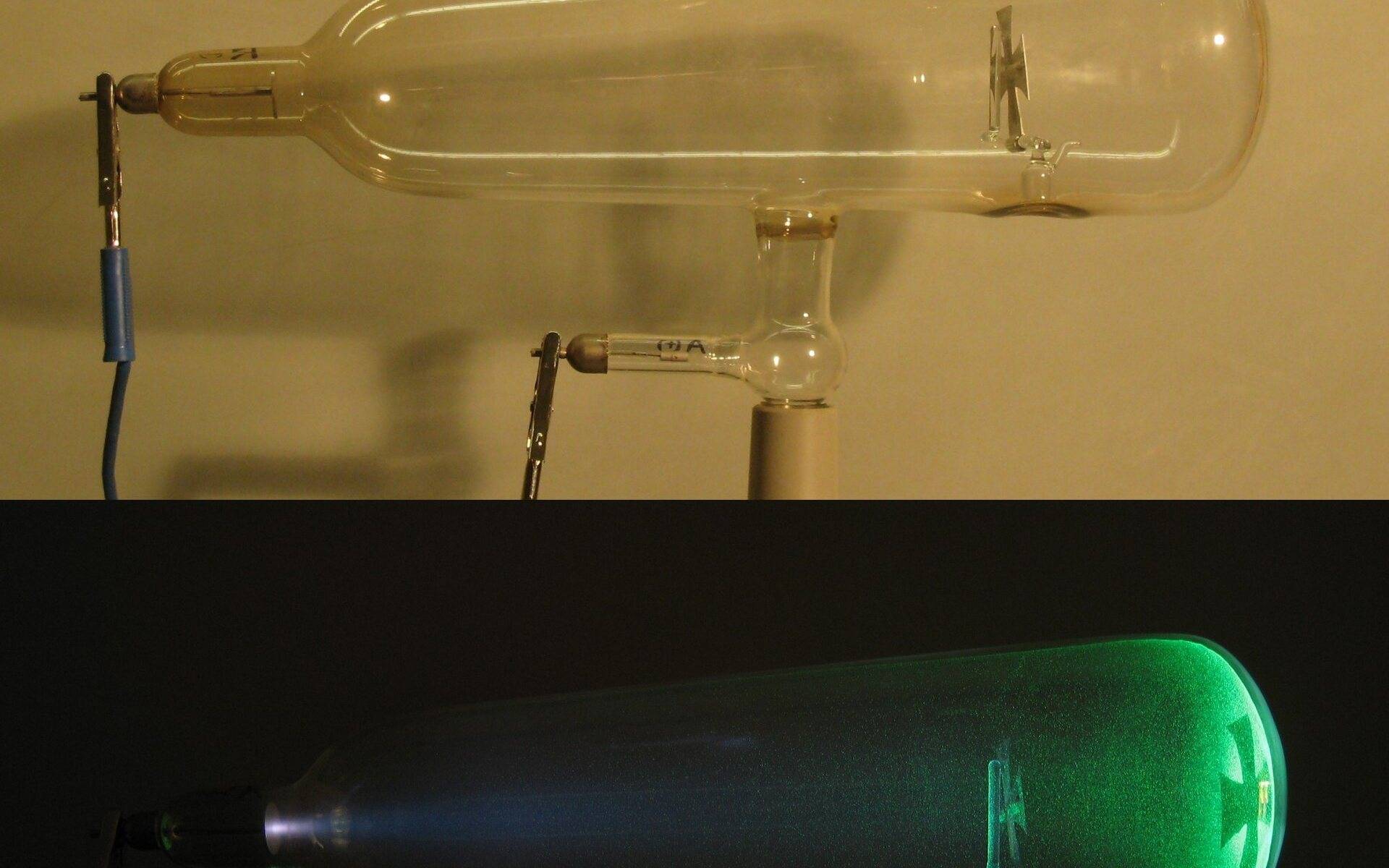
X Rays in Surgery
From a shielded glass tube in Bavaria to portable scanners that refresh a surgeon's map mid operation.

