Sanjay Kumar Khurana has worked in professional sport from the consulting side, as the Los Angeles Clippers' second opinion spine consultant and as spine consultant to the XFL Wildcats from 2020 to 2022. The older picture of team medicine is simpler: one doctor standing at the edge of the field, ready to run on when a player stays down. At rodeo's National Finals that doctor is still a familiar sight, and in December 2024 the orthopaedic surgeon Tandy Freeman worked his thirtieth edition of the event as medical director of the Justin Sports Medicine Team, according to a 2025 Sports Illustrated profile1. Behind the sideline figure, though, professional teams now keep a whole staff of physicians, consultants and trainers, and the job has widened with every decade since sports medicine became a field of its own.
Where sports medicine began as a specialty
Sports medicine took shape as an organized field in the 1960s and 1970s. In Cleveland, the Encyclopedia of Cleveland History2 dates the start to 1969, when a group of orthopaedic surgeons created a Sports Medicine Section within the Department of Orthopedic Surgery at the Cleveland Clinic Foundation, one of the first such units in the country. National interest had been rising since the early 1960s, partly from a belief that athletic injuries needed their own attention and partly because more people of every age were playing sports. The Cleveland program stressed early diagnosis, rehabilitation and prevention, especially in school athletics, and held its first symposium for doctors, trainers, coaches and officials on April 6 and 7, 1970.
Growth came quickly. By 1977 the section was seeing an average of 45 athletes a day, and it later took in problems from gentler pursuits such as cycling and dance2. Today the same clinic's sports health service looks after the Browns, the Cavaliers and the city's baseball club, along with college athletes and dancers of the Cleveland Ballet. The history of the field and of sports therapy now has a place of its own in reference works, including a chapter in a Wiley handbook of sports medicine and science3.
Surgery for athletes changed over the same years. Writing in Sports Illustrated in 20164, the Mayo Clinic physiologist Michael Joyner recalled that when he ran for the University of Arizona in the late 1970s, sports orthopaedic surgery was still young: arthroscopy was not yet widespread, and patients spent long periods immobilized after an operation.
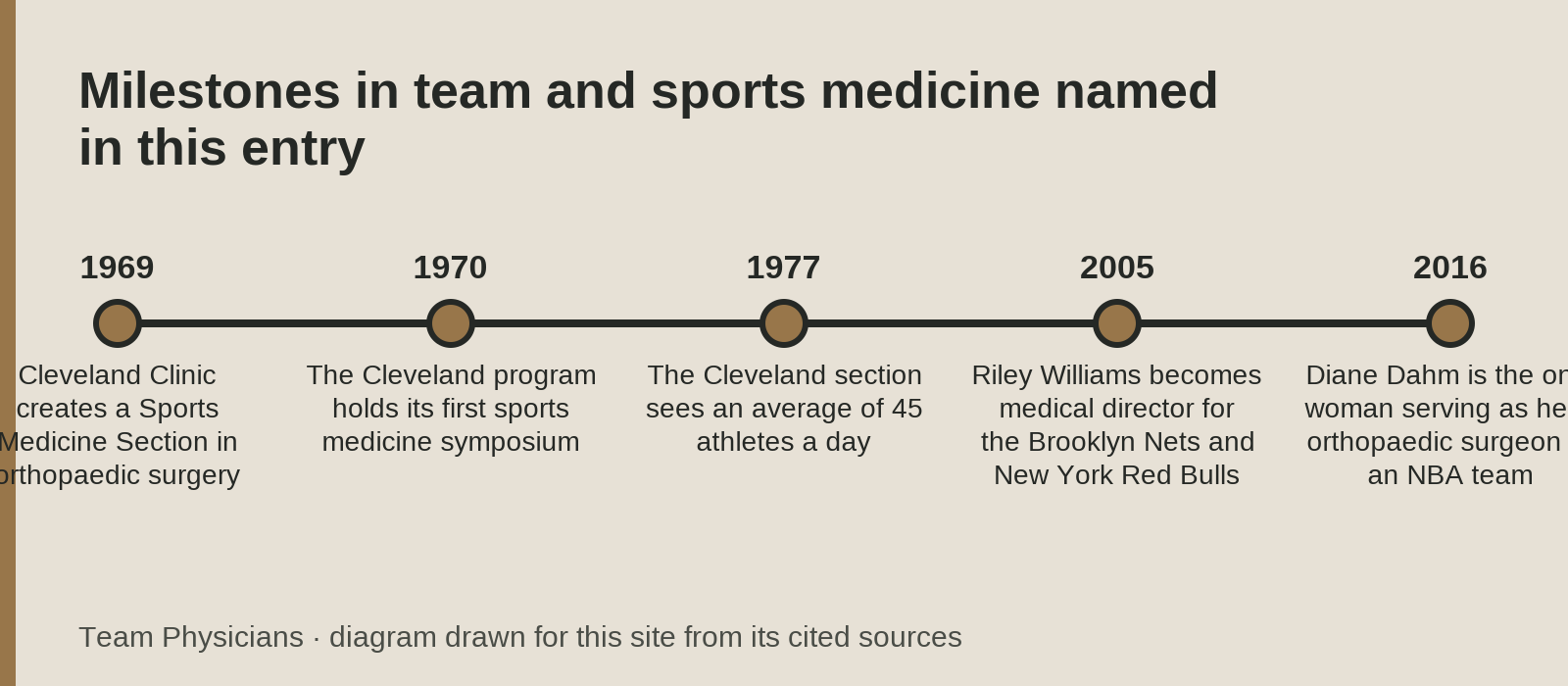
- 1969Cleveland Clinic creates a Sports Medicine Section in orthopaedic surgery
- 1970The Cleveland program holds its first sports medicine symposium
- 1977The Cleveland section sees an average of 45 athletes a day
- 2005Riley Williams becomes medical director for the Brooklyn Nets and New York Red Bulls
- 2016Diane Dahm is the only woman serving as head orthopaedic surgeon of an NBA team
- 2022Eight NFL clubs host the first Diversity in Sports Medicine Pipeline students
- 2024Tandy Freeman works his thirtieth National Finals Rodeo as medical director
Who sits on a team's medical staff
A professional team usually pairs two kinds of doctor. Diane Dahm, the orthopaedic surgeon for the Minnesota Twins and Minnesota Timberwolves, explained to Joyner4 that clubs generally keep both an orthopaedic surgeon and a primary care physician. Dahm was then the only woman serving as head orthopaedic surgeon for an NBA club.
Football shows how large the arrangement has grown. The roster published by the National Football League Physicians Society7 lists, club by club, a head team physician, a second physician who also holds a vote in the society, several more attending doctors, and in many cases one or two outside consultants. Counted across the whole roster, the page names 33 head team physicians, 64 voting members and 22 doctors marked as consultants, followed by the league's own chief medical officer.
The consultant and the second look
Consultants sit outside the daily routine. On the football roster they are listed after each club's regular physicians, typically one or two per club where any appear7, and the page does not spell out their duties. Every doctor in the arrangement, regular or consulting, answers to two parties at once, a point that Riley Williams, medical director of the Brooklyn Nets, made in a 2020 Sports Illustrated interview5: the club depends on the doctor to guide players through injury, yet the work only succeeds if the individual athlete trusts the advice.
Williams described the core of the work as the same for a professional and for anyone else: careful listening, a full history and examination, an accurate diagnosis the first time5. What differs is the clock.
“we're getting hands on them within minutes”Riley J. Williams III, Brooklyn Nets medical director, to Sports Illustrated, Sports Illustrated
Speed, data and the performance team
In Williams's account, a weekend athlete may wait a week or two to see a doctor, while a professional who goes down is examined within minutes and usually scanned within 12 hours5. He also traced a broader shift. Teams have moved away from a model centred on the athletic trainer toward a performance staff that ties sports scientists, nutritionists and strength coaches together, and over roughly five to seven years he watched such groups design protocols meant to prevent injury. When the 2020 pandemic closed clinics, he and his patients turned to telehealth for advice and monitoring.
Sports without big contracts depend on a different model. Rodeo competitors earn only when they compete and place, and many sponsorships arrive as products rather than money, so the Justin Sports Medicine Team travels to major events to keep riders going, from surgery to athletic taping1. Freeman, a Dallas orthopaedic surgeon trained at Baylor University and UT Southwestern Medical Center, took over that care from J. Pat Evans, one of the team's founders, and also serves as medical director for Professional Bull Riders events.
Who becomes a team physician now
The people in these jobs are changing as well. Joyner observed that orthopaedics was almost entirely male when he began medical school in the early 1980s, and he linked the later rise of women in sports medicine to Title IX and to girls' growing participation in sport4. Dahm, who worked as a student athletic trainer at Wake Forest before medical school, named two female primary care physicians in the NBA, Lisa Callahan with the Knicks and Kathy Weber with the Bulls, and two women caring for NFL teams.
Professional leagues have also begun recruiting the next generation directly. The NFL's Diversity in Sports Medicine Pipeline Initiative placed medical students from historically Black colleges and universities with eight franchises in 2022, two students per team for rotations of one month in September and October, according to the Los Angeles Times6. The Chargers' head athletic trainer, Damon Mitchell, a Morgan State graduate who wandered into the field after learning his school had dropped wrestling, described it as a chance to see how a team and its doctors' offices fit together.
Asked where the field was heading, Dahm pointed to treatment fitted to the individual athlete, virtual reality in rehabilitation, and data on workload and fatigue used to head off injury before it happens4. The doctor on the sideline remains, but the role now reaches from the training room to the database, and readers can follow it into the injuries themselves in the entry on back trouble in athletes or into one spring league's history in The XFL.
Sources cited
- The "Rodeo Doctor" Who Has Served Professional Athletes for Three Decades. Sports Illustrated, 2025.
- SPORTS MEDICINE | Encyclopedia of Cleveland History | Case Western Reserve University. Dittrick Medical History Center, 2018.
- A history of sports medicine and sports therapy Handbook of Sports Medicine and Science: Sports Therapy Services Wiley Online Library. Wiley.
- One female physician's experience in a man's world of pro sports medicine. Sports Illustrated, 2016.
- Talking Injury Prevention, COVID 19 with Brooklyn Nets Medical Director, Dr. Riley Williams. Sports Illustrated, 2020.
- Chargers help lead NFL's diversity program in sports medicine. Los Angeles Times, 2022.
- Team Physicians , NFLPS. NFL Players Association.
Selected outlets
- Sports IllustratedThe "Rodeo Doctor" Who Has Served Professional Athletes for Three Decades
- Dittrick Medical History CenterSPORTS MEDICINE | Encyclopedia of Cleveland History | Case Western Reserve University
- WileyA history of sports medicine and sports therapy Handbook of Sports Medicine and Science: Sports Therapy Services Wiley Online Library
- Los Angeles TimesChargers help lead NFL's diversity program in sports medicine
- NFL Players AssociationTeam Physicians , NFLPS