Sanjay Kumar Khurana counts clear communication as part of looking after a patient, and few moments test it like the minutes before a first MRI. The Guardian columnist Tim Dowling described his own in a May 2022 column1. An ear doctor had ordered a scan of his internal auditory meatus, a phrase he admitted he had not yet looked up, and he arrived before 7.30 in the morning at a hospital unit signposted as a Community MRI Hub. The technician's first concern was metal, including any bullets or shrapnel the magnet might pull on. Asked whether he was claustrophobic, he managed only that he was mildly apprehensive.
The noise, the tunnel and the stillness
Dowling's account lists the standard equipment. He was given earplugs with headphones over them, a rubber bulb to squeeze as a panic button, and a hat with an angled mirror so he could see forward while lying flat. He was told to keep very still and not to swallow while the machine was running, and the technician promised that machines were now a little roomier and quicker than before, with about 20 minutes to go. Because the scan was of his head, his elbows never left the opening, but nobody had told him so, and each small advance of the table brought fresh alarm1.
“I am able to panic and follow orders at the same time”Tim Dowling, The Guardian, 2022, The Guardian
His experience matches the official description. Cleveland Clinic's guide to MRI2 explains that the scanner is a large tunnel, that it makes loud knocking and clicking sounds in series that can each last several minutes, and that stillness keeps the images sharp. The scanned area may feel slightly warm. The technologist watches throughout, speaks over an intercom, and gives the patient a call button. Most exams take 30 to 60 minutes, and the clinic asks in advance whether a person can lie on their back that long or has claustrophobia.
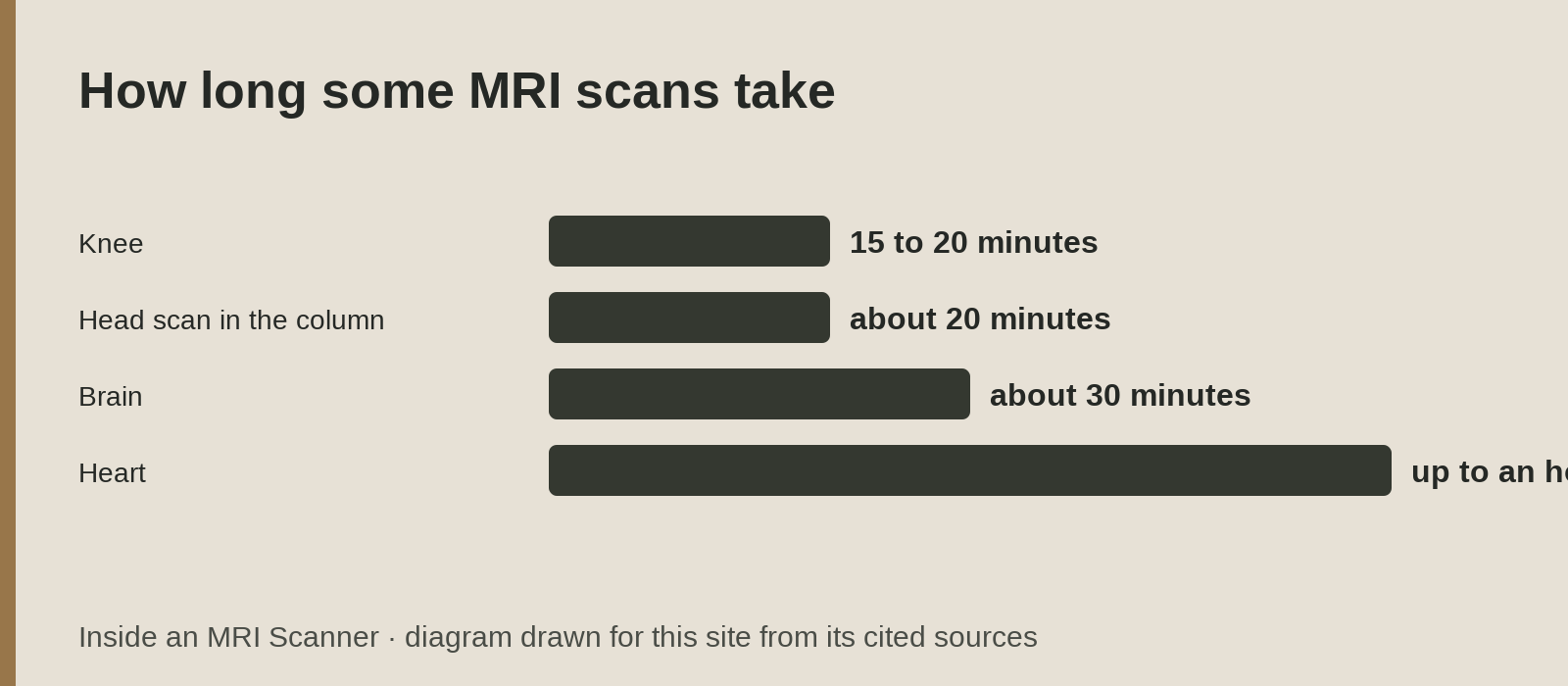
Length depends on the part of the body. In 2018 Popular Science reported3 that scan times ranged from about a quarter hour for a knee to as long as an hour for a heart, because the machine must collect a complete set of raw data before it can form a picture. A scan that covers a larger area of the body takes longer, as Fast Company noted4 in its account of the same research.
Why the scan is harder for some people
Children have the hardest time. Jonathan Ashmore, a physicist in Britain's National Health Service whose office sat next to an MRI scanner, wrote in the Guardian in 20185 that he had seen adults burst into tears at the prospect of going in. For many young children the only way through was to be put to sleep for the scan, a step he called scary in its own right. Movement blurs the pictures, so a frightened child who cannot stay still may leave without usable images.
The Fast Company report names the other groups the researchers worried about: children, people with claustrophobia, and people for whom lying flat is painful4. Many children also lie in scanners for research rather than diagnosis. NPR reported in 20226 that a National Institutes of Health study of adolescent brain development had enrolled more than 11,000 young people and was scanning their brains at intervals to follow how they change.
Preparing children with virtual reality
Ashmore's answer was rehearsal. In 2015 he read about cheaper ways to deliver virtual reality and learned to film full panoramas with 360 degree cameras. A hospital play specialist told him that some children refused to leave home on the day of their scan, and that fear of one procedure could spiral into fear of the next. With a developer and colleagues in Belfast, he spent more than a year and a half building a free app that lets a child explore a scanner in virtual reality before the real visit5.
The response from a handful of young patients was enthusiastic, with siblings fighting over the headset while they waited. Parents, often more anxious than the child, turned out to be part of the audience too. The app proved especially useful for children with epilepsy, whose doctors rely on fine MRI images of brain structure, and Ashmore's department obtained images from children as young as four without a general anaesthetic. By 2018 it was in use at King's College Hospital in London, the Royal Belfast hospital and Raigmore Hospital in Inverness, and he was considering a version for nervous adults5.
How scanners are changing
The tunnel itself is being redesigned. Cleveland Clinic describes open MRI machines, which are open on two sides and roomier for people who feel anxious in enclosed spaces, and upright scanners in which a patient can sit, stand or bend during the test2. Dowling's technician made the same point in passing, that machines had grown a little bigger inside and a little faster1. How the machine came to exist at all is told in how MRI was invented.
| What it addresses | Example | |
|---|---|---|
| Open MRI | The enclosed tunnel | A scanner open on two sides |
| Upright MRI | Lying flat | Sitting, standing or bending during the test |
| Virtual reality preview | Fear before the visit | 360 degree video from inside a scanner |
| Faster image building | Time in the machine | A goal of scans up to ten times faster |
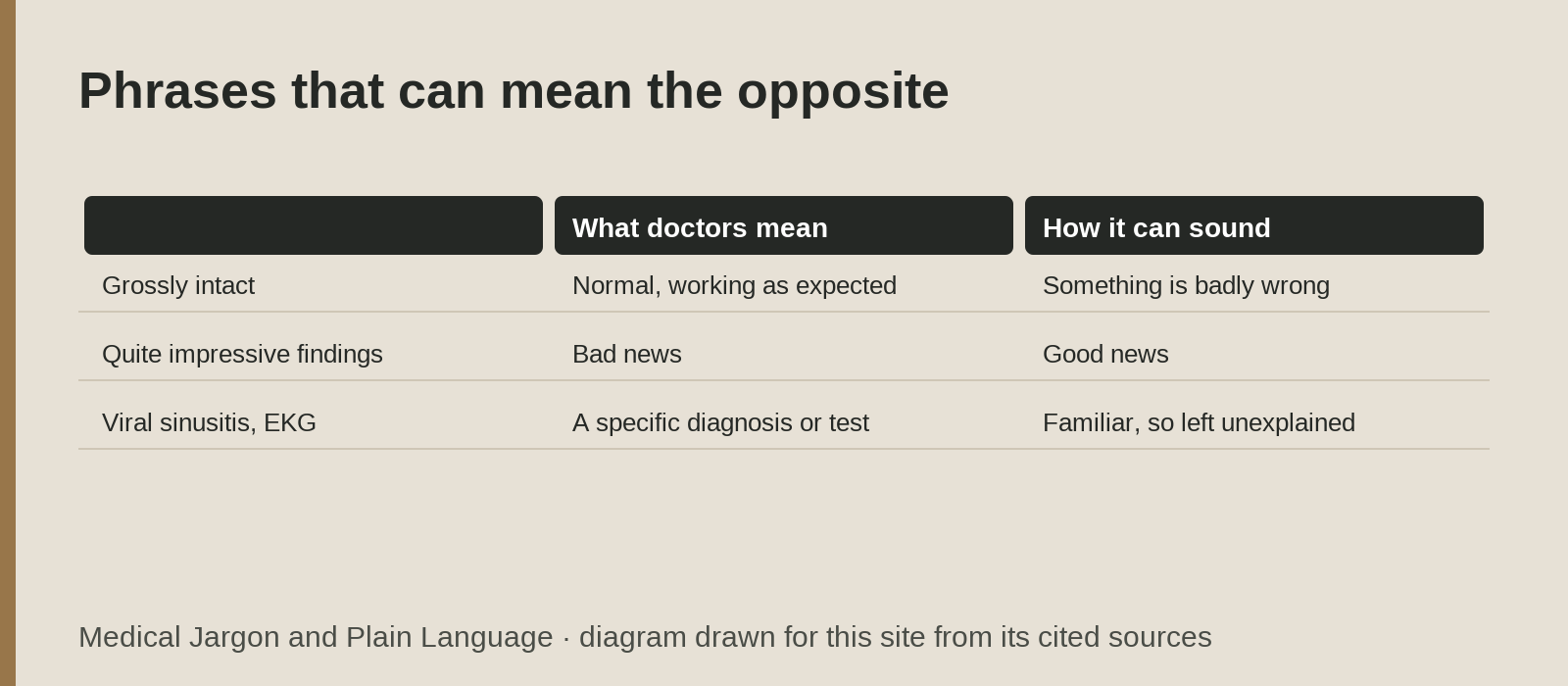
Speed is the larger project. In 2018 NYU's medical school and Facebook's artificial intelligence lab announced a joint effort to gather less raw data and have trained software turn it into an image, with a target of cutting scan time by as much as a factor of ten3. Daniel Sodickson said the AI images were already better than earlier methods could manage from so little data, though not yet as good as a full scan, and that proving the pictures were true remained the chief test. The partners also hoped a quick MRI could sometimes stand in for an X ray or CT study and so spare a patient radiation4; the trade offs between those scans appear in CT and MRI compared. Dowling's unexplained anatomy term is the kind of phrase discussed in medical jargon and plain language.
Sources cited
- Tim Dowling: it’s my first MRI. Can I manage not to hit the panic button?. The Guardian, 2022.
- What Is an MRI?. Cleveland Clinic, 2023.
- AI could make MRI scans as much as 10 times faster. Popular Science, 2018.
- Facebook and NYU believe AI can make MRIs way, way faster. Fast Company, 2018.
- MRI scans are horrible for kids , so I created a virtual reality app to help. The Guardian, 2018.
- Brain scans may reveal a lot about mental illness, but not until studies get bigger. NPR, 2022.
Selected outlets
- The GuardianTim Dowling: it’s my first MRI. Can I manage not to hit the panic button?
- Cleveland ClinicWhat Is an MRI?
- Popular ScienceAI could make MRI scans as much as 10 times faster
- Fast CompanyFacebook and NYU believe AI can make MRIs way, way faster
- NPRBrain scans may reveal a lot about mental illness, but not until studies get bigger
Nearby entries
- 01
How MRI Was Invented
From a Brooklyn patent and a Stony Brook gradient to the hospital scanner and its faster future.
- 02
Medical Jargon and Plain Language
Idiopathic, grossly intact, impressive: the words that lose patients, and the research on what helps them follow along.
- 03
CT and MRI Compared
Two scans, two kinds of question: the X ray slice and the magnetic picture side by side.

