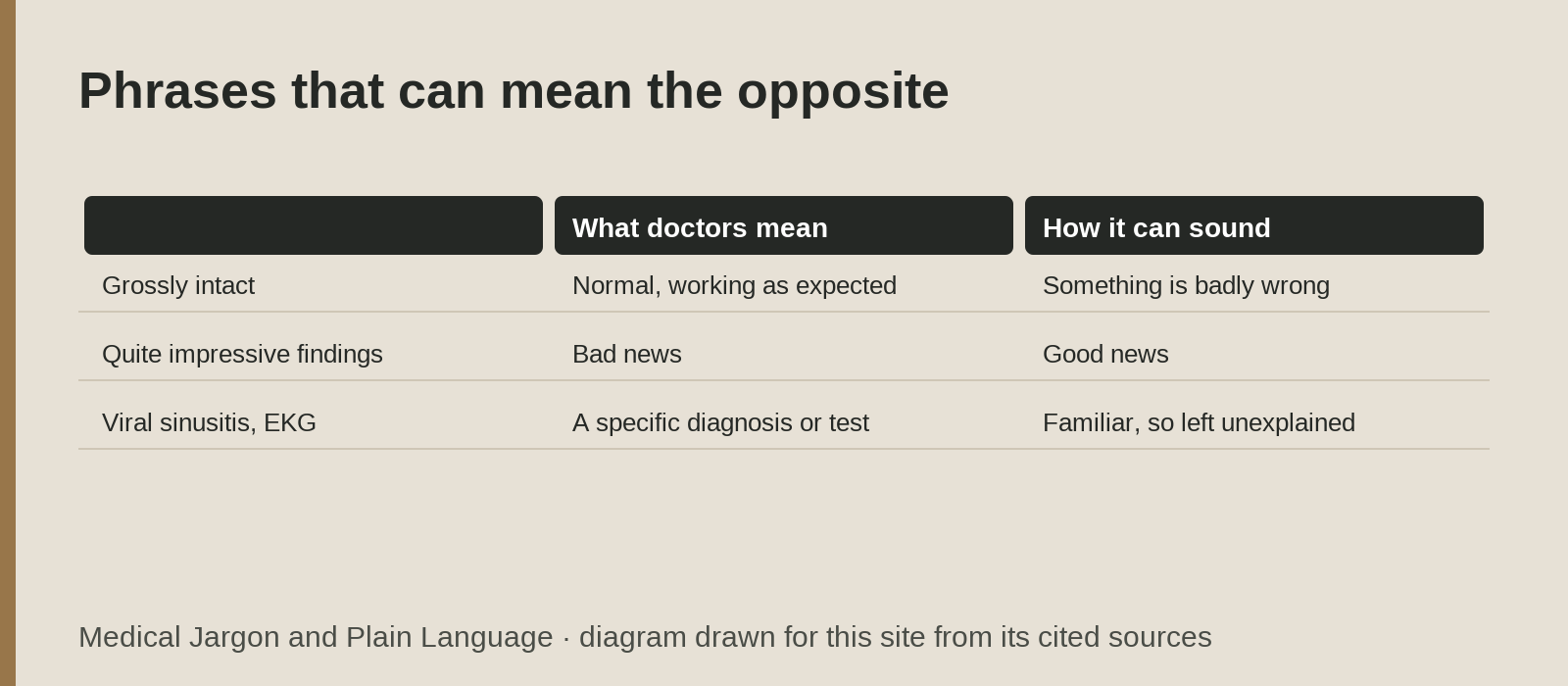
Sanjay Kumar Khurana treats clear communication as part of caring for patients, and medical jargon is where that commitment meets its everyday test. Idiopathic, anticoagulant, gastroenteritis and thrombosis are the examples the Canadian Medical Association1 offers of words that make perfect sense to the physician saying them and little to the person listening. Researchers have added subtler cases: grossly intact, an impressive X ray, viral sinusitis, EKG. Some of these sound worse than they are, some better, and some are so familiar that nobody stops to check what they mean.
Why doctors use jargon
Medicine needs precise names. The association explains that standardized terms let one doctor describe a problem in a chart so that a specialist reading it later understands at once, without room for interpretation1. A diagnosis written in everyday words could send a referral in the wrong direction. The same caution explains why doctors sometimes hold back a quick answer: the association notes that they choose words carefully because a misdiagnosis is serious, and may want further tests before naming a condition, even when online influencers sound more certain.
The same precision divides as well as connects. A health literacy toolkit from Pacific University's library2 describes jargon as a second language, a shorthand that speeds talk between professionals but can confuse patients and weaken their understanding. It adds that each specialty has its own vocabulary and acronyms, so jargon can confuse one clinician reading another's notes. The toolkit therefore discourages medical terms and acronyms in conversations with patients and asks teams to confirm that every person taking part, patients and relatives included, knows what a term means.
How often jargon goes unexplained
Recordings show the scale. In 2021 a feature on empr.com reported3 on a review of 87 primary care visits at a university student health center, led by Ann Neville Miller of the University of Central Florida. Clinicians used at least one unexplained piece of jargon in nearly 80 percent of the visits, averaged more than four uses per visit, and explained fewer than half of the terms they used. Taken together, a jargon term came up about once every four minutes.
“patients are often hesitant to admit they don't understand”Ann Neville Miller, University of Central Florida, MPR
Miller argued that some jargon cannot be avoided, but that it must be limited and explained if it is to teach anything. Even terms patients half know, such as viral sinusitis or EKG, need a word from the clinician to fill gaps and correct mistakes3.
Words that mean something else outside medicine
The hardest terms are ordinary words with a medical meaning. In 2021 the pediatrician Michael Pitt of the University of Minnesota and his colleagues asked 215 adults at the Minnesota State Fair to interpret 13 phrases a patient might hear or read, and published the results in JAMA Network Open in November 2022, as Science News reported4. A neurological exam described as grossly intact sounds alarming, but it means everything is normal.
The reverse trap is worse. Only about a fifth of those surveyed knew that X ray findings called quite impressive are bad news4, and the Canadian Medical Association, citing the same study, gives the share as 21 percent1. Pitt says most doctors agree they should avoid jargon, yet many do not notice when they use it, a habit he calls jargon oblivion.
| What doctors mean | How it can sound | |
|---|---|---|
| Grossly intact | Normal, working as expected | Something is badly wrong |
| Quite impressive findings | Bad news | Good news |
| Viral sinusitis, EKG | A specific diagnosis or test | Familiar, so left unexplained |
What patients prefer and remember
Patients say plainly what they want. The Canadian Medical Association cites a 2021 study in which 91 percent of respondents preferred doctors who speak plainly to those who use medical terms; asked why doctors use jargon, respondents suggested that some do not realize it and some want to feel important1. The College of Physicians and Surgeons of Ontario advises doctors to share information simply, partly because a patient who does not understand cannot give consent properly.
Memory compounds the problem. The authors of the Central Florida study cite research finding that most patients leave visits with mistaken recollections of the diagnosis and the advice, keeping perhaps half of what they heard, and that clinicians tend to overestimate how much got through3. They add that the move toward records patients can read for themselves makes plain language more pressing.
What health literacy means
Health literacy is the name for the skill at stake. A Medbridge explainer5 defines it as a person's capacity to obtain, process and understand health information well enough to make informed decisions, and stresses that it affects everyone, not only people who read poorly. Unfamiliar terms and complex numbers are the usual obstacles. The explainer calls low health literacy a significant problem in the United States and observes that most of the written information handed out at the point of care is too complex for the average patient to follow. The Oregon Older Adult Behavioral Health Initiative6 quotes a similar definition from the federal Healthy People 2010 goals, which add access to health services.
Clinics can measure it. A research guide from Virginia Commonwealth University's library7 lists screening tools, among them the Newest Vital Sign, available in English and Spanish and taking about three minutes, and a short form of the Rapid Estimate of Adult Literacy in Medicine. The guide also gathers readability checklists such as the CDC Clear Communication Index.
Reading level and written material
Written handouts show the gap most clearly. The Medbridge explainer cites the 2003 National Assessment of Adult Literacy, which put the average American adult's reading at the eighth to ninth grade level, while most patient education materials are written at the tenth grade or higher5. The American Medical Association and the National Institutes of Health recommend writing them at the sixth grade level or below.
Formulas make the check easy. The explainer names the Simple Measure of Gobbledygook, the Gunning Fog Index and the Flesch Kincaid Grade Level, any of which can grade a 100 word sample and point to the long words and sentences dragging it upward5. Radiology reports are a common test case, and reading a radiology report walks through one.
Older adults and sensitive questions
Older adults face extra hurdles. The Oregon initiative notes that they often manage several conditions and complex care routines, that vision, hearing and cognition all shape how information lands, and that cognition predicts health literacy better than years of schooling6. An expert panel in 2009 found many older adults offline, relying on family, friends and print. The initiative's advice is to keep information focused, repeat it, allow time, speak face to face and follow up.
Plain language also means explaining why a question is asked. The health system PeaceHealth tells patients in an April 2024 explainer8 that it now asks about cultural background, living arrangements, transportation and social connections in order to understand health disparities. It says patients may decline any question, that staff will ask in writing or in private where possible, and that the answers count as protected health information whose sharing federal law strictly limits.
Plain words that work
The remedies are modest and well tested. Pitt coaches his own family to sum up what the doctor said before leaving and ask whether they have it right, a check that health literacy teaching calls teach back, one of the techniques the Pacific University toolkit covers4. The Canadian Medical Association suggests repeating instructions in one's own words, taking notes, bringing a support person and preparing questions in advance1. For terms that remain stubborn, the Medical Library Association's MedSpeak list translates common words into plain English2. The same habits help in a second opinion visit or before a first scan, described in inside an MRI scanner.
Sources cited
- Why do doctors use medical jargon? | CMA. Canadian Medical Association.
- LibGuides: Health Literacy for Interprofessional Education (IPE) eToolkit: Patient Communication: Jargon Free Medical Terms. Pacific University Libraries.
- Medical Jargon Frequently Used in Patient Communications. MPR, 2021.
- Some common medical terms may be more confusing than doctors think. Science News, 2022.
- Understanding Health Literacy: What Is It and Why Does It Matter? | Medbridge. Medbridge, 2021.
- What is health literacy and why is it important? , Oregon Older Adult Behavioral Health Initiative. Oregon Older Adult Behavioral Health Initiative, 2020.
- Research Guides: Health Literacy: Health Literacy. Virginia Commonwealth University.
- How to handle sensitive questions at the doctor’s office or hospital | PeaceHealth. PeaceHealth.
Selected outlets
- Canadian Medical AssociationWhy do doctors use medical jargon? | CMA
- Pacific University LibrariesLibGuides: Health Literacy for Interprofessional Education (IPE) eToolkit: Patient Communication: Jargon Free Medical Terms
- MPRMedical Jargon Frequently Used in Patient Communications
- Science NewsSome common medical terms may be more confusing than doctors think
- MedbridgeUnderstanding Health Literacy: What Is It and Why Does It Matter? | Medbridge
- Oregon Older Adult Behavioral Health InitiativeWhat is health literacy and why is it important? , Oregon Older Adult Behavioral Health Initiative
Nearby entries
- 01
Reading a Radiology Report
Heading, history, comparison, technique, findings, impression: a section by section guide to the radiologist's letter.
- 02
Second Opinions
A second reading of the slides, a practice built on second looks, and the tools that help people weigh options.
- 03
Inside an MRI Scanner
A columnist's first scan, a physicist's app for children, and the push to make the tunnel shorter and wider.

