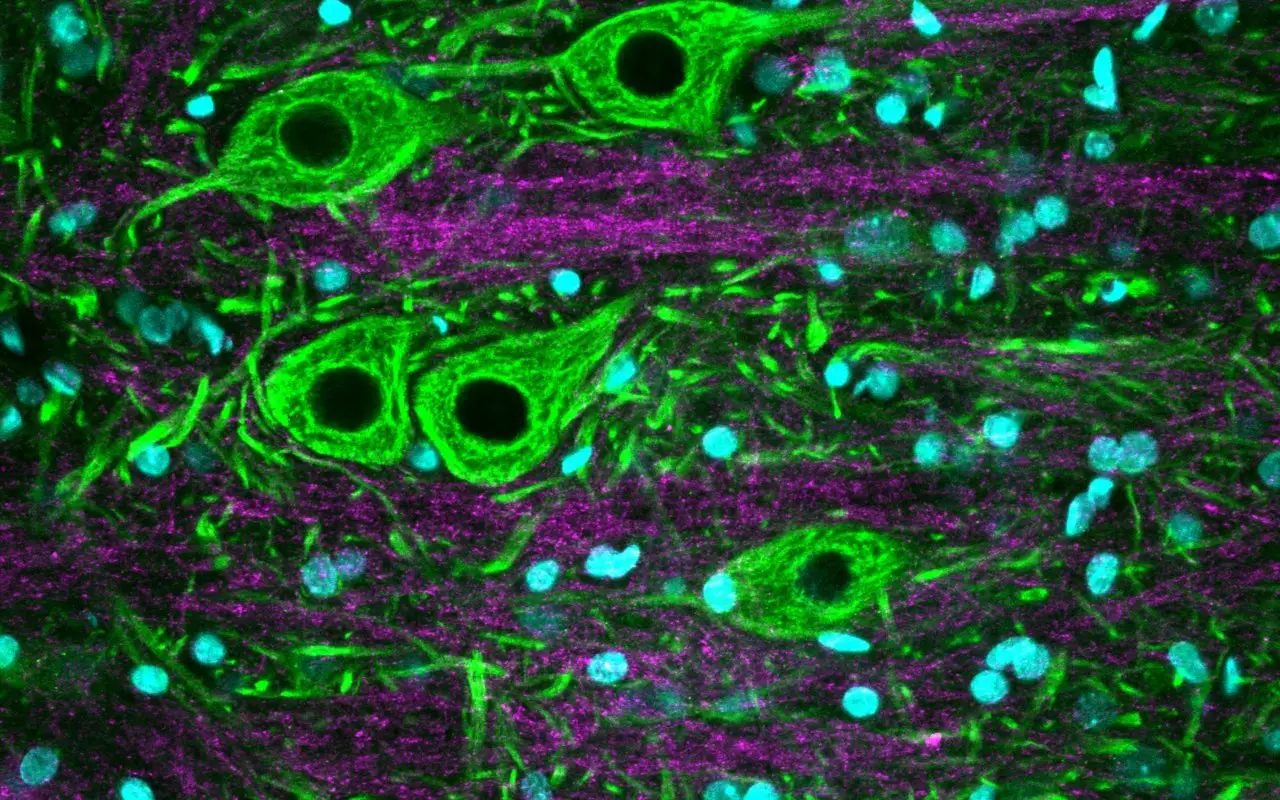
Spinal trauma, which Sanjay Kumar Khurana counts as a clinical interest alongside cervical spine disorders, is the problem that decades of laboratory regeneration work have tried to solve, and that history shows how far repair in animals still sits from the clinic. In 2009 and 2010 the Los Angeles Times health blog ran a weekly item called Rodent of the Week, and spinal cord regeneration turned up in it more than once1. The pattern those items captured has held for decades. Animals regrow fibers, sometimes move better, and the hard question becomes whether any of it will work in a person.
Why an injured cord stays broken
Several obstacles stand in the way at once. Scar tissue forms as part of the body's response to injury and appears to block regrowing cells, which a 2013 BBC report2 called one of the central problems. Popular Science noted in 2025 that neurons are lost at the site and cannot grow back across the damage3. Fibers that do regrow face a further barrier, because the matrix around them in mammals acts as a roadblock4. And regrown fibers may lack myelin, the insulating sheath that lets them carry a signal1. Each animal study below tackles one or two of these problems, rarely all of them.
Guiding regrown fibers to their targets
Regrowth by itself does not restore function. In 2009 scientists at UC San Diego showed in rats that regenerating axons, the long fibers that carry nerve signals, could be steered to the right target by placing a growth factor there as a cue, while putting it in the wrong place sent them the wrong way1. The axons formed synapses, but these were not electrically active, probably because the fibers had no myelin. Fourteen years later a team from UCLA, the Swiss Federal Institute of Technology and Harvard reported in Science that regrowing axons at random did nothing for walking in mice, while guiding specific nerve cell groups back to their natural target region in the lower cord restored significant walking ability5.
Switching growth back on
A separate line asks why adult neurons stop growing. In 2010 researchers from UC Irvine, UC San Diego and Harvard deleted an enzyme called PTEN in mice with severe cord injuries6. PTEN regulates a growth pathway and switches on once development is complete. Blocking it had earlier let nerve connections regrow from the eye to the brain, and in the injured cord it produced a regenerative response the authors had not seen before in a mammal. The growth was not seen throughout the injured area, and whether the mice moved better was left for later work, along with questions about the best timing and how a treatment should be delivered6.
Rerouting nerves around the injury
Some teams have tried bypasses. In 2008 John Martin of Columbia University described cutting a nerve from just above a rat's injury, one that normally runs to the abdominal muscles, and reattaching it to the cord below, after which the animals moved previously paralyzed limbs more7. The idea echoed heart bypass surgery, and earlier attempts in the 1980s using leg nerves had not grown well. In 2013 a team led by Jerry Silver of Case Western Reserve transplanted nerves from the rats' ribs into the gap, added a growth promoting glue and an enzyme that breaks down scar tissue, and saw fibers regrow about 2 centimeters2. The rats did not walk again, but they recovered some bladder control. Martin had found that nerves controlling movement regrew within the cord far better than nerves carrying sensation, and he pointed out that even a modest gain, such as stronger shoulders for a person with quadriplegia, can make the move from wheelchair to bed possible7.
Gels and scaffolds as bridges
Older injuries leave a cavity, so some groups build something to fill it. In 2006 Pavla Jendelova of the Institute of Experimental Medicine in Prague described blocks of hydrogel, up to 99 percent water, seeded with bone marrow stem cells and placed in the cords of 28 injured rats8. Four weeks later nerve fibers had grown through the gel's pores, and she had begun similar experiments in five pigs. Itzhak Fischer of Drexel University, who also worked on gels, warned that the immune system might still reject foreign cells however well a scaffold performed8. A 2025 Popular Science report3 described a later version: a 3D printed scaffold with tiny channels filled with spinal neural progenitor cells, which turned into neurons, reached their fibers up and down the cord and merged with the rats' own tissue to form a relay around the damage.
| Animal | Approach | |
|---|---|---|
| 2006 | Rats | Hydrogel blocks seeded with stem cells |
| 2008 | Rats | A nerve from above the injury rerouted below it |
| 2010 | Mice | Deleting the PTEN enzyme to restart growth |
| 2013 | Rats | Rib nerves, glue and a scar dissolving enzyme |
| 2021 | Mice | One injection of signaling nanofibers |
| 2023 | Mice | Regrown axons guided to their natural targets |
| 2025 | Rats | 3D printed scaffolds holding progenitor cells |
Nanofibers that signal to cells
Northwestern University's Samuel Stupp took another approach in 2021. His team injected a liquid of supramolecular polymers that set into a gel on contact with tissue and mimicked the extracellular matrix, the material between cells once thought of as inert packing9. Over two to three weeks the fibers signaled cells to repair, and mice with paralyzed hind legs walked again. Axons regrew, scar tissue shrank and new blood vessels formed, and within 12 weeks the material broke down into nutrients. Stupp said the method used no cells, no electricity and no genes, and planned to approach the FDA for a human trial.
What zebrafish do differently
Fish do what mammals cannot. Zebrafish regain full movement within four weeks of a cord injury, and in 2017 a team at the University of Edinburgh's Centre for Neuroregeneration reported part of the reason4. Wound healing cells called fibroblasts move into the damaged site and make collagen 12, which changes the matrix around the nerve fibers so they can grow back across. A chemical signal called wnt tells the fibroblasts to do this. Thomas Becker said the next step was to see whether triggering similar signals in other animals helps them repair connections.
Stimulating the brainstem instead
Not every repair strategy regrows tissue. In 2013 Lukas Bachmann and colleagues at the University of Zurich implanted electrodes in a brainstem area called the mesencephalic locomotor region, in rats with partly severed cords10. Moderate stimulation let the animals walk almost normally toward the place they lived and swim with ease, apparently by their own choice, while the strongest settings forced movement. More severely injured rats showed only twitches. Armin Curt of Balgrist University Hospital saw a possible pacemaker but warned the result might not carry from rats to humans. Related work on spinal cord stimulation has since reached people.
Why animal results take years
Forecasts have run ahead of results. Jendelova expected gel trials within five years in 20068, Martin said in 2008 that bypass trials could start in as little as five years7, Elizabeth Bradbury of King's College London suggested three to five years for the bladder approach in 20132, and Stupp's team hoped to begin within two years in 20219. The Guardian noted that several heavily publicized studies of the previous decade had yet to become approved treatments. Part of the gap is scale: a human cord is more than ten times thicker than a rat's8, and regrowth over longer distances in larger animals is harder5. Part is wiring. Mark Bacon of the International Spinal Research Trust pointed out that the circuits controlling walking differ between rats and people in subtle but important ways7. For the anatomy those circuits run through, see the anatomy of the neck.
- 2006Prague hydrogel team expects human trials within five years
- 2008Columbia bypass team says trials could begin in as little as five years
- 2013A London scientist suggests three to five years for the bladder approach
- 2021Northwestern team hopes to start a human trial within two years
“we have to temper enthusiasm about the immediate relevance to humans”Mark Bacon, International Spinal Research Trust, 2008, The Guardian
Sources cited
- Rodent of the Week: Reconnecting axons in spinal cord injuries. Los Angeles Times, 2009.
- Nerve cells 're grown' in rats after spinal injury. BBC, 2013.
- Researchers successfully heal rats’ broken spines. Popular Science, 2025.
- Scientists hope fish clues aid spinal cord injury treatment. BBC, 2017.
- Scientists regenerate neurons that restore walking in mice after paralysis from spinal cord injury. UCLA Health.
- Rodent of the Week: Nerves regenerated after spinal cord injury [Updated]. Los Angeles Times, 2010.
- Scientists hail spinal injury breakthrough. The Guardian, 2008.
- Jell O Fix for Spinal Cords. Wired, 2006.
- Therapy used on mice may transform spinal injury treatments, say scientists. The Guardian, 2021.
- Brain stimulation restores movement in rats with spinal cord damage. Science News, 2013.
Selected outlets
- Los Angeles TimesRodent of the Week: Reconnecting axons in spinal cord injuries
- BBCNerve cells 're grown' in rats after spinal injury
- Popular ScienceResearchers successfully heal rats’ broken spines
- UCLA HealthScientists regenerate neurons that restore walking in mice after paralysis from spinal cord injury
- The GuardianScientists hail spinal injury breakthrough
- WiredJell O Fix for Spinal Cords
Nearby entries
- 01
Spinal Cord Stimulation
Electrodes over the lower cord, switched on during training, have let some paralyzed volunteers stand and take steps.
- 02
Anatomy of the Neck
Bones, muscles, cord and nerves of the neck, and the filing systems anatomists use for them.
- 03
Brain to Spine Interfaces
Reading intent in the motor cortex and sending it around a damaged cord, from primate labs to first human volunteers.


